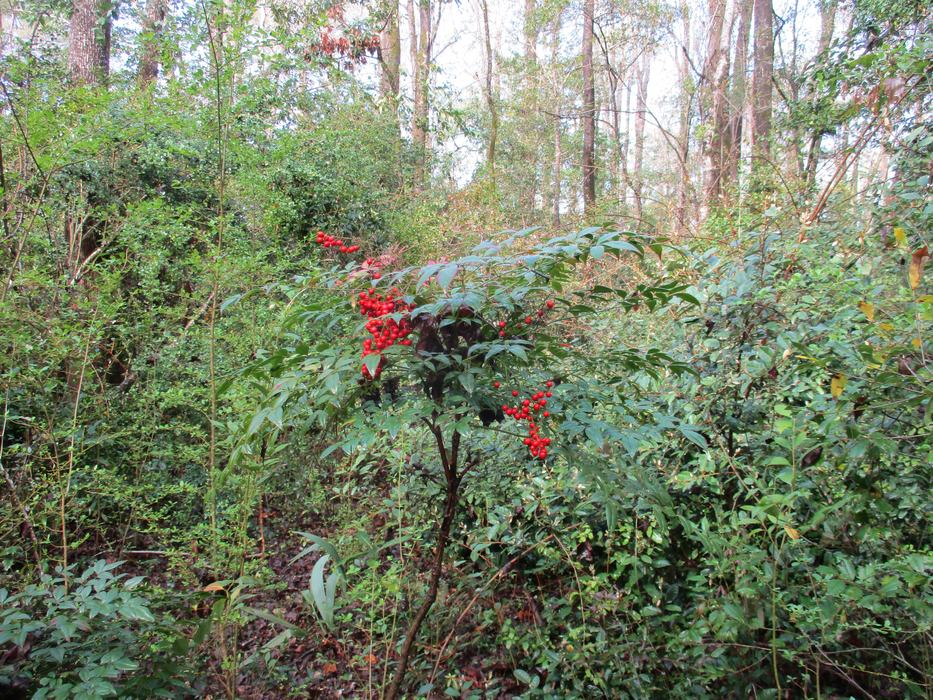
Nandina (Nandina domestica) has been known for some time to be an invasive non-native plant capable of displacing native plants in natural areas. It may not be as serious a problem - currently - as Bradford pear, Chinese wisteria, English ivy, eleagnus, Chinese privet, Japanese honeysuckle, Japanese stilt-grass and others. But it is a significant threat nonetheless, and deserves closer attention in our plant selection and plant removal efforts.
The North Carolina Extension Gardener Plant Toolbox entry identifies nandina as " ... an invasive species in North Carolina", and urges use of native plants instead; or, as another alternative, "one of the dwarf cultivars that do not produce fruit". The cultivars 'Fire Power', 'Gulf Stream', 'Harbor Belle', 'Lemon Lime', and 'Nana', are described as "nearly fruitless" or having almost no fruits. 'Harbor Dwarf' is said to produce no fruits. Even with one of these selections in the landscape, it would be worth the time to watch for and remove any fruits that do develop. According to the Plant Toolbox, "Berries contain cyanide and when consumed in quantity can be toxic to birds."
On recent visits to a large wooded tract in Craven County, I noticed 4 separate infestations of Nandina domestica, with multiple plants at each location. An environmentally-friendly task for 2022 would be to start the process of removing nandina from your home or business landscape, unless the plants are among the dwarf cultivars with little or no fruit production.