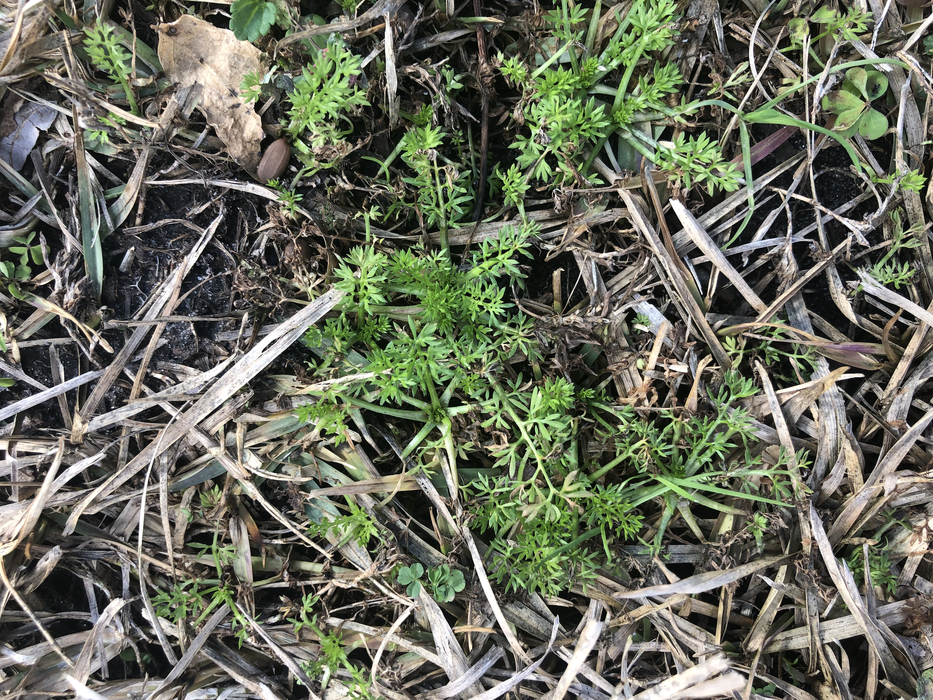
Lawn burweed (Soliva sessilis) is a winter annual, as distinct from the summer annual grassy weed known as sandspur or sandbur (Cenchrus spp.). The two are often confused, as they have similar-sounding names and they both produce very sharply pointed seed-bearing structures that can be a real nuisance for people and pets. January is the time of year to focus on lawn burweed.
Homeowners with centipedegrass have a couple of chemical control options. One is to spot spray with atrazine, which has both pre- and post-emergent properties. Atrazine can also be applied in November to control newly-germinated lawn burweed plants, and to prevent at least some of the burweed seed bank from germinating. Another option is to spot spray with one of the many three-way products containing 2,4-D + MCPP + Dicamba. Your window of opportunity for using the three-way products won't be very long, however. Centipedegrass begins greening up very early in the year, certainly by early March or even at some point in late February. During greenup centipedegrass is very susceptible to damage from 2,4-D and many other herbicide products. (However, atrazine is much safer on centipedegrass and can be used about anytime.) Aside from the herbicide sensitivity issue, lawn burweed begins growing very quickly by March and control becomes much more difficult. Once the hard, sharp burs have formed, chemical control of the foliage is pointless because the burs will remain behind.
As is usually the case with lawn weeds, chemical control is not the only or even most important strategy. According to an information note from Clemson, "Maintain a healthy, dense lawn by fertilizing and liming according to soil test results and mowing at the proper height and frequency for the specific turfgrass in the lawn. Healthy lawn grasses can outcompete burweed for light, water, and nutrients and reduce the level of infestation." For additional information on this topic, see also Lawn Burweed Control from the N.C. Cooperative Extension, Currituck County Center.