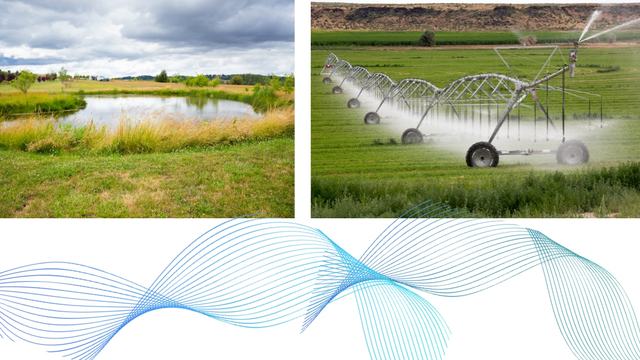
Water farming may be used in the future to prevent devastating flood damage to homes, businesses, buildings and infrastructure during extreme rainfall or tropical storm events. The general idea is to establish a small pond on existing farmland to capture rainfall during these storm events. By creating multiple sites upstream from properties that frequently flood or are located in a floodplain, one can store enough water on the farm to slow runoff and reduce or eliminate flooding. Water could be stored within these ponds for 1-5 days and slowly released so as not to cause flood damage.
One experimental system has been established on the Caswell Research Farm in Kinston, NC. A 2.0 acre pond captures runoff from about 140 acres of farmland. The farmland and pond has been estimated to “hold” about 30 acre-feet of water. This one pond can reduce downstream peak flow 47% during a 100 year storm event. As just one pond, this is good, but not enough to prevent downstream flood damage. However, multiple sites such as this would impact flooding. As a positive side for farmers, this 2.0 acre pond will also hold enough water to irrigate a corn crop of about 50 acres.
Numerous NC State University faculty are coordinating research to determine the potential impacts of these water farming systems. Positive impacts to the environment, farmers, landowners, and downstream infrastructure are expected. First, these systems hold water allowing sediments to settle on the pond bottom rather than the sediment begin transported to nearby waterways. This not only reduces the sediment load to these water but also decreases the amount of nutrients deposed with the sediment. Furthermore, the ability to irrigate greatly reduces nitrogen and phosphorous offsite movement compared to dryland farming simply because irrigation ensures that one does not have a disastrous yield due to drought. Simply put, removal of nutrient from crop harvest ensures only a small amount of nutrients remain on the field. This is advantageous in further reducing the nutrient deposit into environmental sensitive areas.
As an example, consider that nutrients are removed from the field harvest of 160 bu/ac of corn typically removes 100-110 lbs./ac of nitrogen, about 60 lbs./ac of phosphorous, and about 40 lbs./ac of potassium. (This is a reasonable yield and expectation for good soils within Eastern NC. ) Now consider that under a non-irrigated farming system aiming for the same yield, one may or may not reach this target. In fact, most years this will not occur if one relies on rainfed conditions. We simply do not consistently have adequate soil water available for corn at critical reproductive stages. In fact, the NC state corn average is roughly 140 bu/ac simply because we currently do indeed rely upon rainfed conditions. As such, we do not actually remove these nutrient if the yield is not met. In fact, during disastrous yield, virtually all of these nutrient remain in the soil and are at high risk of leaching loss. So, ensuring a steady, high yield through irrigation, one can actually achieve reasonable yield goals that will remove nutrients that would have otherwise be lost to the environment. This will enhance our ability to protect nutrient sensitive waterways.
This system can also be implemented for pine forest. However, rather than a pond, forest acres simply includes establishment of trenches between the rows of tree to hold water. Water is held within these trenches for 1-4 days after the storm and then slowly released. Research shows these systems provide similar positive impact of flood prevention downstream and holding the water on the pine forest for such a limited time does not negatively impact the pine’s growth. As an added benefit, the “flooding” for just a few days does reduce the undesirable underbrush.
While such systems do offer potential positive impacts, there are indeed still some issues to overcome. A few of these are listed below:
- Much of our farmland is not owned by farmers. A typical farming operation within Eastern NC will own 30-40% of the farmland managed. The rest is owned by other individuals. As such, for this effort to succeed, the landowners must be willing to participate.
- Should both the farmer and landowner cooperate, they both must realize that the emphasis of the system will be placed on reduction of downstream flooding. Any program or promotion for the installation of these system may, or may not, have funding or incentives to include irrigation. If irrigation is not included, this system will provide benefit for society, but not the farmer.
- Ideally, if irrigation is included, the entire system must still be maintained. Ditches and water collection infrastructure will need routine maintenance. Too, over time, sediment may fill the pond reducing water holding capacity. Even pond management will become an issue to prevent weeds and algae from becoming a problem. These cost need to be included in any type of incentive should one be provided.
- Another issue is that to be effective, someone or agency must monitor these systems by region or watershed. It will be critical to precisely know the storage capacity of these systems before a storm event occurs. Just as critical, one needs to understand the water flow after these storms so stored water can safely be released safely without creating downstream flooding.
- As with all systems, there are always exceptions. As example, should an excessive amount of rainfall fill ponds during the winter months and adequate rainfall persist through the field crop growing summer month, no water would be needed for irrigation. Thus, the pond would be “full”. In this case, one would need to release excess pond water during late summer or very early fall so that these systems would have the water holding capacity for any tropical storm system that might arrive in the fall. Similarly, there might be years of extremely low winter and summer rainfall. In this situation, irrigation would be desired by the farmer but the pond may not have adequate water capacity to allow irrigation. Again, exception always occurs.
- It may require policy and someone to manage these policies to ensure the system works as intended. Too, as with all new efforts, some education for those involved will aid success. Should the venture be successful, it should be maintained. Offering incentives to landowners and farmers seems reasonable since these systems will be preventing flooding of homes, businesses, streets, infrastructure, etc. This will also relieve insurance companies, government, and citizens of the cost of damage, loss of business operation, and rebuilding. In some areas, this may result in saving millions of dollars. As such, it seems feasible that those downstream provide some financial incentive for continued operation and protection. However, what this value should be, how it might be paid, to whom payments or incentives would apply, will need to be established.