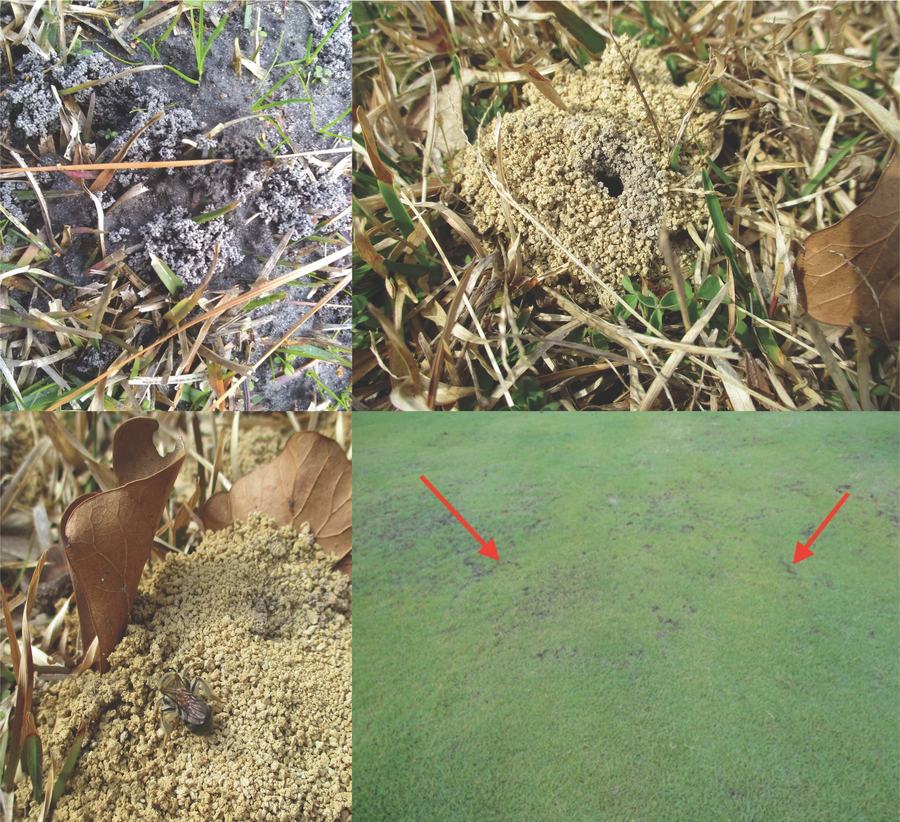
According to entomologists at NC State University, over the past several years mole crickets have become the number one insect pest of home lawns, golf courses, municipal and commercial properties, and sod farms along the North Carolina coast. Unfortunately, greater awareness of this pest has also led to many cases of "false positives", with ground bee and earthworm activity frequently being mistaken for mole cricket activity. All too often, this leads to insecticide applications that succeed only in killing beneficial insects. Regarding the various ground bees, the individual nests can occur in great numbers, giving the appearance that the lawn is being destroyed. In reality, they're just exploiting thin stands of turf with lots of open area. They're not aggressive and are not a threat to people, and they also will not be evident on the site for the entire year. But if you prefer they not be around, the best way to reduce the numbers is to encourage a denser stand of turf through aeration, fertilization, and as-needed irrigation.
Back to mole crickets - the good news is that damage is fairly easy to recognize, and with a soapy water drench you can flush the suspects out of hiding, if they are present. This should be done prior to any insecticide applications for mole crickets. See the Clemson Information note on mole crickets for a description of the soapy water drench.
While June has traditionally been the recommended treatment time for this pest, a particularly warm winter can change things. For example, in an April 9, 2020, Mole Cricket Alert, NC State's Terri Billeisen stated the following: "This spring, the adult mole crickets are causing much more damage than we typically observe. These large crickets are even more difficult to control and typically we don’t recommend spending money trying to control them. However, in many locations, the damage is quite serious and, this spring, we may need to be more aggressive. Whenever possible, try to control mole crickets early in the spring to target nymphs and adults of both the southern and tawny mole cricket, interrupting their life cycle before the adults have a chance to lay eggs."
The Main take away from this article should be scouting, correct pest identification, and proper timing of insecticide application.